
Factory & Quality Control
Why Melamine-Faced Panels Crack After Lamination: 4 Root Causes and Prevention Steps
A panel can leave the press looking perfect and still develop fine cracks later. This guide connects defect patterns with substrate, paper, pressing and handling controls.
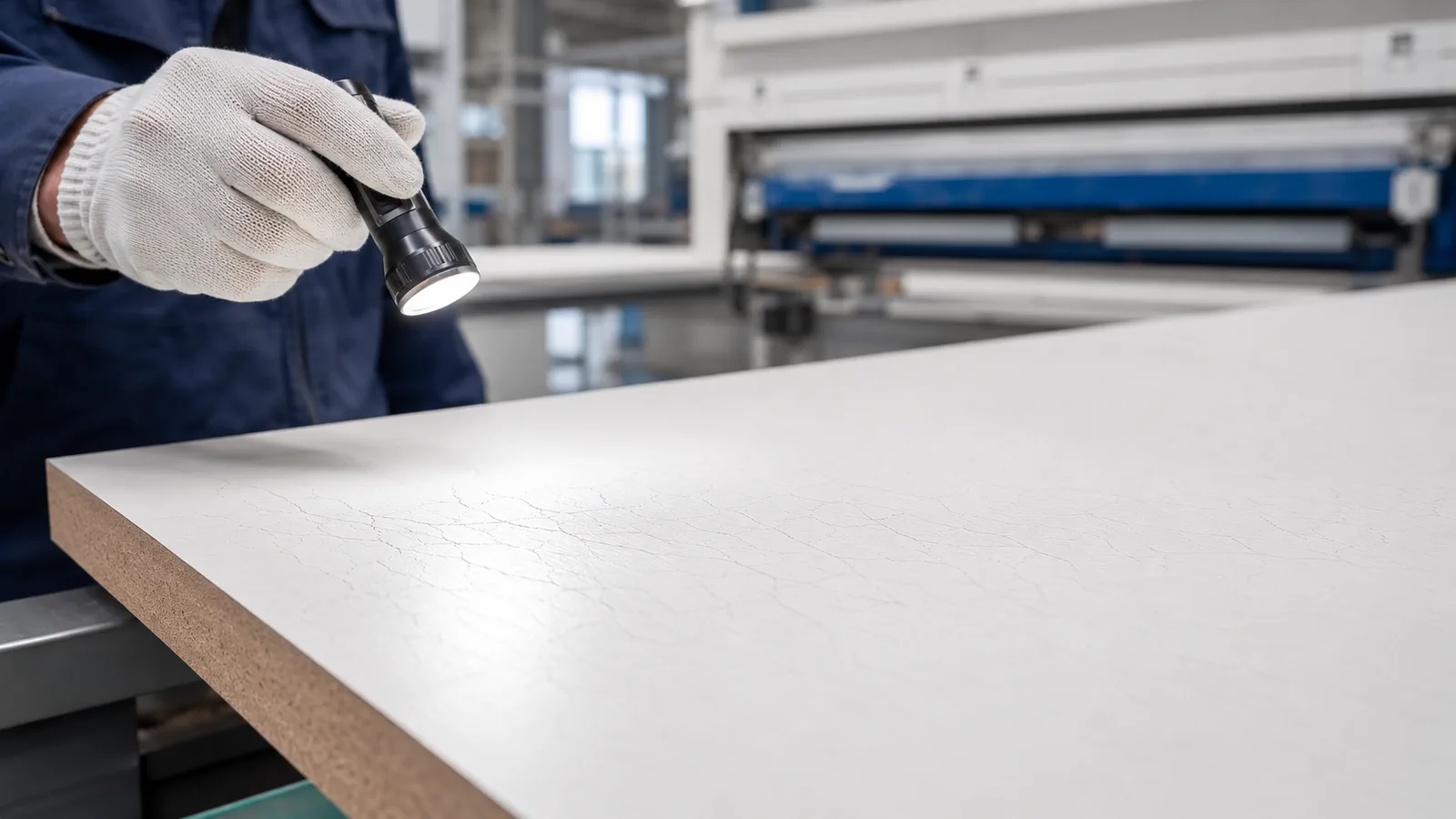
A melamine-faced panel may look smooth and stable immediately after hot pressing, yet develop fine surface cracks during cutting, edge banding, transport or installation. This can be frustrating because the defect often appears after the panel has passed the factory's first visual inspection.
Surface cracking is rarely caused by one isolated mistake. In most cases, stress has built up somewhere in the system formed by the substrate, impregnated paper, press cycle and downstream environment. Understanding that system is the fastest way to prevent repeat claims.
What does surface cracking look like?
The defect usually appears as fine lines in the decorative surface. Depending on the cause, the cracks may be:
- concentrated near panel edges or machined areas;
- distributed across the full sheet;
- aligned with the sanding direction or internal structure of the board;
- visible only after bending, cutting or edge banding; or
- delayed until the panels experience a different temperature or humidity.
The pattern matters. It helps distinguish a brittle overlay from substrate movement or mechanical damage.
Root cause 1: moisture and internal stress in the substrate
MDF, particle board and plywood all respond to moisture. If the substrate enters the lamination line with uneven or excessive moisture, the heat of pressing can temporarily flatten the panel without removing the underlying imbalance.
The risk may remain hidden until the board is cut, routed or moved into a drier or more humid climate. The substrate then expands or contracts, releasing internal stress into the much thinner decorative layer. If the overlay cannot accommodate that movement, it cracks.
This is why a panel can pass inspection at the press and fail later in a customer's factory.
Useful controls
- Condition the substrate before lamination.
- Measure moisture at several points, not only on one sheet.
- Check thickness, density profile and surface soundness by batch.
- Avoid mixing panels from very different storage environments in one production run.
- Allow panels to acclimatize before intensive machining when the destination climate differs greatly from the production climate.
Root cause 2: brittle or unstable impregnated paper
Decorative paper must contain enough resin to form a continuous, durable surface, but it must also retain the flexibility needed for normal panel movement and machining.
Problems can occur when the paper is over-cured, has an unsuitable resin balance, has been stored poorly, or is no longer compatible with the selected press cycle. An overly brittle sheet may press cleanly and still crack when the panel receives a light impact or passes through an edge-banding line.
The lowest-priced paper is not always the lowest-cost option. A small saving on the overlay can be lost quickly through rejected panels, rework and customer complaints.
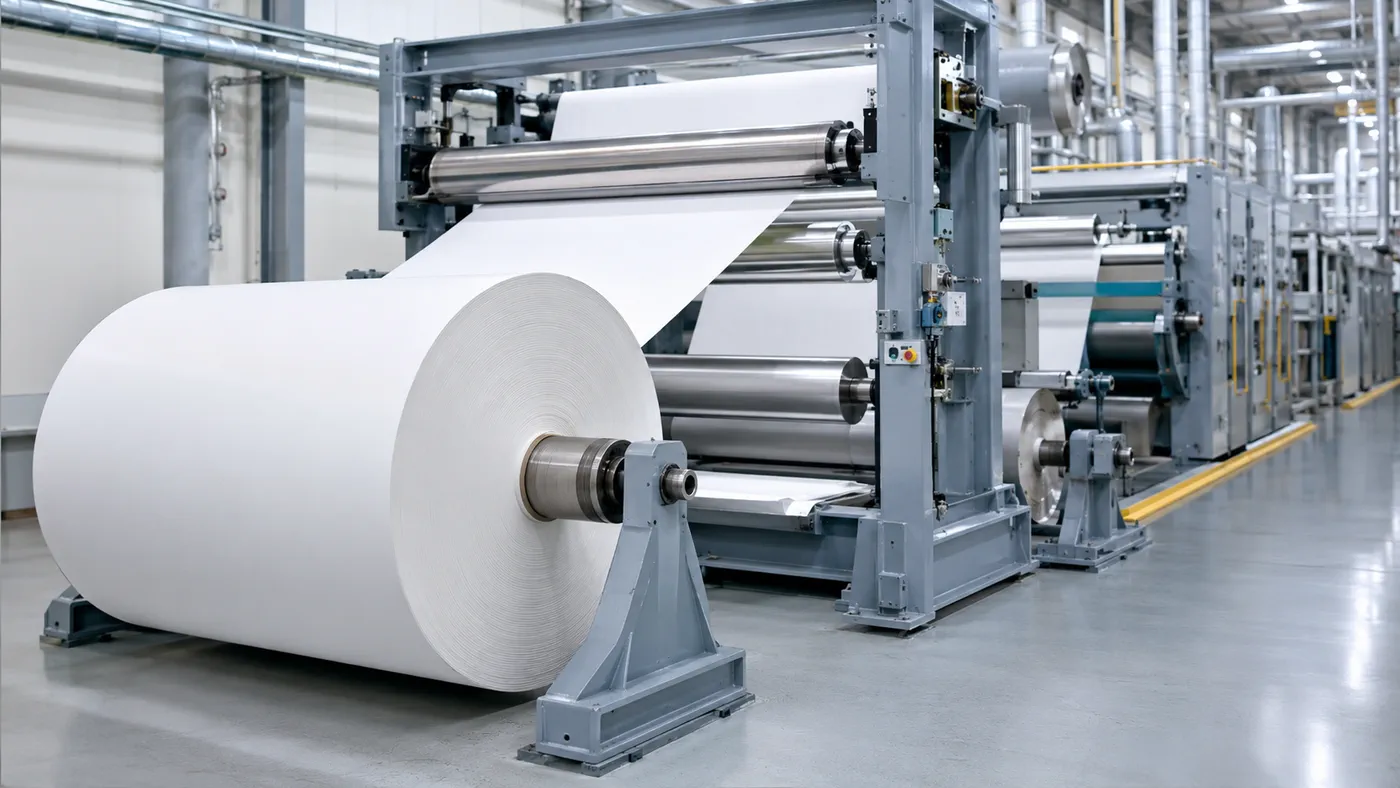
Stable paper production and controlled storage help keep resin loading, moisture and curing behavior consistent.
Useful controls
- Keep paper sealed and protected from heat and humidity.
- Record the paper supplier, design, batch and storage time.
- Confirm resin content, volatile content and curing behavior for the application.
- Requalify the press recipe when changing paper supplier, color, grammage or finish.
- Test both flat appearance and post-press machining performance.
Root cause 3: a press cycle that does not match the material system
Temperature, pressure and time work together. A recipe that performs well with one paper and substrate combination may not suit another.
If the surface cures too quickly, the resin layer can become brittle before the whole interface has stabilized. If heat or pressure is uneven, one area may be fully cured while another remains under-processed. Press platens, cushioning materials and textured plates also affect heat transfer and pressure distribution.
Rather than relying on one universal setting, a factory should validate a process window for each important material combination.
Useful controls
- Verify platen temperature across the usable area.
- Check that pressure is distributed evenly.
- Monitor actual cycle time, including loading and release.
- Inspect press plates and cushioning materials for wear or contamination.
- Approve a first-off panel before full production begins.
Root cause 4: machining, handling and climate exposure
Even a correctly laminated panel can be damaged by an unsuitable saw blade, excessive bending, rough stacking or rapid environmental change. Cracks that appear around cut edges may be a machining issue rather than a lamination failure.
Transport also matters. Containers, unconditioned warehouses and project sites can expose panels to large temperature and humidity changes. Unprotected edges absorb and release moisture faster than the panel face, creating additional stress.
Useful controls
- Use sharp, correctly selected cutting tools.
- Support full-size sheets during movement and machining.
- Protect corners, faces and edges in the package.
- Keep packs dry and level during storage.
- Allow closed packs to reach the local environment gradually before processing.
A quick diagnostic guide
| Crack pattern | Likely area to investigate first |
|---|---|
| Fine cracks across most of the surface | Paper brittleness, curing level or a press cycle that is too aggressive |
| Cracks concentrated at edges or cut-outs | Tooling, machining stress, edge moisture or local substrate weakness |
| Cracks that follow board structure | Substrate sanding, density variation or internal movement |
| Defect appears after transport | Climate change, packaging, storage or residual substrate stress |
| Defect repeats in the same press position | Temperature, pressure, press plate or cushioning uniformity |
This table is a starting point, not a substitute for batch records and physical testing. The strongest diagnosis combines the defect pattern with material and production traceability.
What buyers should confirm before ordering
When comparing melamine-faced panels, specify more than color and thickness. A useful purchase specification should include:
- substrate type and target density;
- emission or glue grade;
- panel thickness and tolerance;
- surface finish and decorative paper requirement;
- intended processing, such as cutting, routing or edge banding;
- end-use environment and destination climate;
- packaging and moisture protection; and
- agreed inspection and claim evidence.
For a new design or a demanding application, a trial sample should be processed on the buyer's actual equipment. A surface that looks good in a small hand sample still needs to prove that it can survive production.
The practical takeaway
Delayed surface cracking is best prevented before the press closes. Stable substrates, suitable impregnated paper, a validated press window and controlled handling all contribute to the final result.
If a crack appears, avoid changing several variables at once. Record the defect location and timing, isolate the affected batches, and test one suspected cause at a time. That approach produces a reliable correction instead of a temporary fix.
When requesting a quotation, tell us how the panel will be machined and where it will be used. Those details help us recommend a more appropriate substrate, surface and packing specification.
Need help with decorative panels?
Send your specification or quality-control question to SOWO.
Share the substrate, thickness, surface, quantity, destination and any defect photos. We can review your application and prepare a factory quotation for the agreed specification.
Request Samples / Get a Factory QuotationMatch the inspection plan to the actual substrate and surface process. Product-specific selection and quotation details are available for Melamine MDF, Melamine Particle Board, Melamine Plywood.