
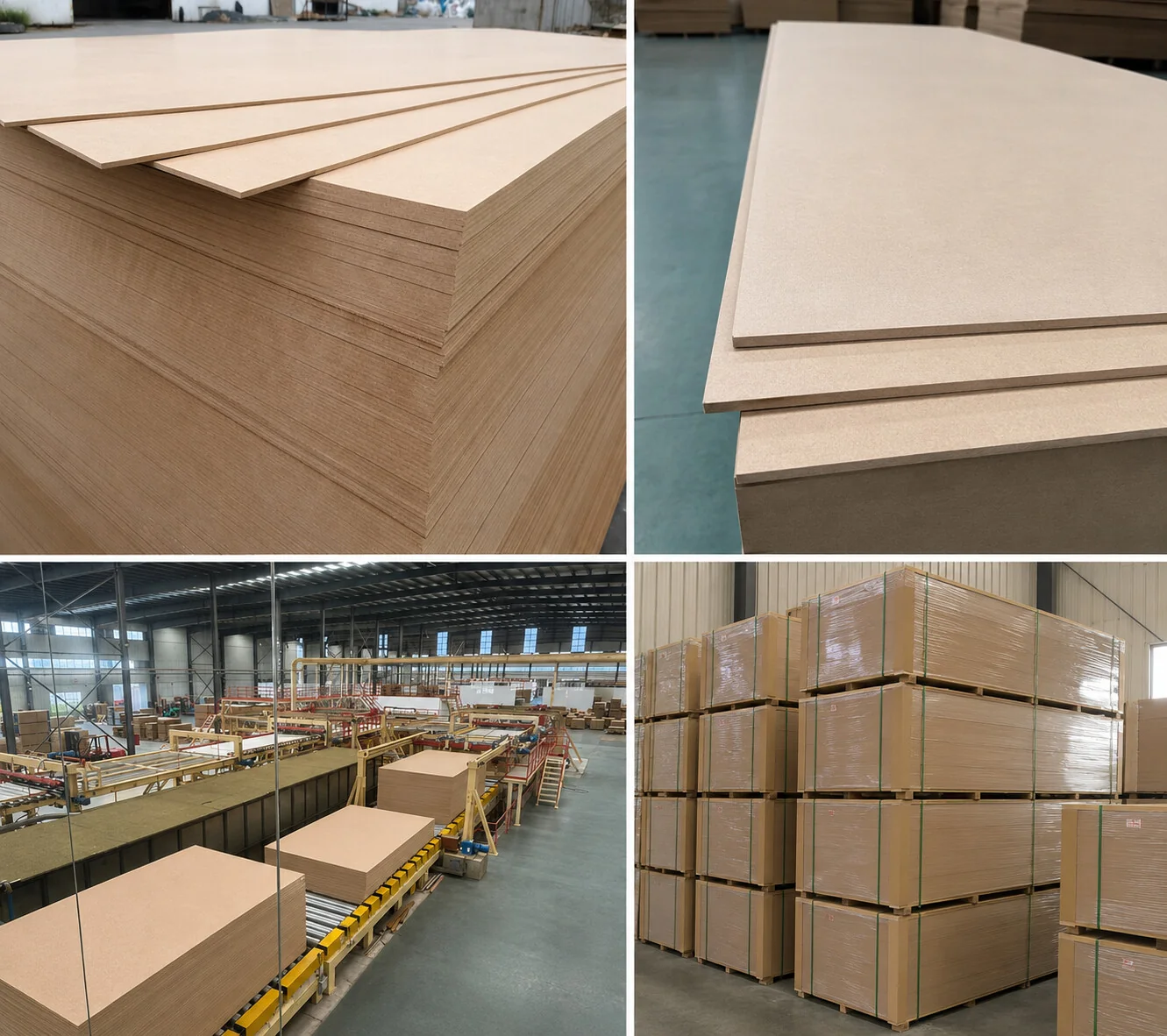
SOWO offers jumbo-size MDF options up to approximately 2135 × 3660 mm (7 × 12 ft), subject to the required thickness and project specification. This guide explains where large-format MDF makes sense, what to check before ordering, and how to prepare a clear request for quotation.
Quick answer: Jumbo MDF is worth considering when a project needs large, continuous surfaces or when an optimized cutting layout makes better use of an oversized sheet. It is not automatically the lowest-cost choice: panel weight, machinery capacity, shipping and offcuts still matter.
What Is Jumbo Size MDF?
MDF (medium-density fiberboard) is an engineered wood panel made from refined wood fibers and resin, formed under heat and pressure. Its relatively uniform internal structure and smooth faces make it a common substrate for painted furniture, decorative finishes and precision machining.
Jumbo size MDF refers to MDF sheets larger than common furniture-board formats, particularly the widely used 1220 × 2440 mm (4 × 8 ft) sheet. The term jumbo is a size description, not a separate quality grade or a promise of higher strength.
A 7 × 12 ft board is especially relevant when manufacturers want to cut unusually tall or wide components, reduce unnecessary joints or arrange multiple parts efficiently on a single sheet. The final advantage depends on the component dimensions and the cutting pattern.
Standard MDF vs. 7×12 ft Jumbo MDF: Size Comparison
| Panel format | Approximate dimensions | Gross area per sheet | Typical buying consideration |
|---|---|---|---|
| Standard MDF (4 × 8 ft) | 1220 × 2440 mm | 2.98 m² | Easier handling and compatibility with common machinery |
| Jumbo MDF (up to 7 × 12 ft) | 2135 × 3660 mm | 7.81 m² | Larger components and potentially more flexible cutting layouts |
One jumbo sheet has approximately 2.6 times the gross area of one standard 4 × 8 ft sheet. That does not mean it will produce 2.6 times as many usable parts. Saw kerf, trimming allowance, grain or surface-direction requirements (where relevant), defects and the shape of the required components all affect actual yield.
For a meaningful cost comparison, ask your production team to create a nesting or cutting plan for both sizes. Compare usable parts per sheet, offcut percentage, cutting time and delivered cost—not only the quoted price per board.
Where Jumbo MDF Is Most Useful
1. Full-height wardrobes and large cabinet components
Tall wardrobe doors, built-in storage systems and oversize cabinet components may benefit from a board with more length. A larger blank may allow the manufacturer to cut a component without assembling smaller pieces first. However, door design, hinges, support, finish and dimensional stability must still be considered.
2. Interior wall panels and decorative features
Large decorative panels can create a more continuous appearance for retail interiors, offices, hotels and residential projects. Fewer visible joints may improve the visual result, provided the installation design allows for movement, safe fixing and site access. Fire-performance requirements should be checked against local rules for the intended use; a jumbo format does not itself provide fire resistance.
3. Furniture factories using CNC or panel-sizing equipment
Factories cutting repeated furniture parts may gain flexibility from a larger nesting area. Whether they gain higher yield depends on the actual parts list and the available machines. Before ordering, confirm the saw or CNC working envelope, lifting arrangements, dust extraction and infeed/outfeed space.
4. Decorative finishing and lamination projects
A smooth MDF substrate may be suitable for painting, veneering or laminating. For an oversize sheet, the finishing line must also accept the board's dimensions. Do not assume that every coating, laminate, press or special MDF grade offered in standard sizes is automatically available in 7 × 12 ft.
When Standard-Size MDF May Be a Better Choice
Oversize is not always better. Standard sheets can be more economical when components are small, machinery is designed around 4 × 8 ft boards, storage is limited, or delivery involves narrow access routes. If the jumbo cutting layout creates unusable offcuts—or demands new handling equipment—its larger gross area may offer little practical saving.
The right decision is based on cost per usable finished component, not simply cost per square meter of raw MDF.
Specifications to Confirm Before Ordering Jumbo MDF
A useful MDF quotation starts with a specification that the manufacturing and logistics teams can check. The following items should be agreed before pricing is treated as final.
Panel dimensions and thickness
Specify the required length × width × nominal thickness in millimeters, rather than relying only on the name “7 × 12 ft.” The advertised maximum format is approximately 2135 × 3660 mm; availability at that format depends on the requested thickness and production arrangement. Also agree on dimensional tolerances and whether any squaring or trimming allowance is needed.
Density and machining requirements
Density influences the weight of each sheet and can affect machining and edge performance. Furniture producers commonly evaluate different density targets according to the intended finish, machining depth and cost. The best density is not necessarily the highest one. If you need help choosing, see our MDF Density Guide.
Surface and finishing process
Confirm whether you need plain sanded MDF for painting or a substrate for veneer, decorative lamination or another finish. State any required face smoothness, sanding condition and machining expectations. The finished surface option and its availability in the jumbo format should be confirmed separately.
Emission and special-performance requirements
Specify the emissions limit together with the applicable market standard and test method, instead of relying on an “E0” or “E1” label alone. If the project calls for moisture-resistant (MR) or fire-retardant (FR) MDF, ask for confirmation of that exact jumbo-size grade and supporting documentation. Standard MDF should not be described as waterproof, and MR MDF is not the same as a waterproof panel.
Order quantity and destination
Include the quantity in sheets, cubic meters or containers; desired Incoterm; destination port; and any particular pallet, labeling or unloading requirements. For large boards, the loading plan needs to be checked before a shipping commitment is made.
Quality Checks That Matter More on Large MDF Sheets
Small inconsistencies can become more noticeable as sheet dimensions increase. Before approving a bulk order, consider the following checks:
- Dimensions and thickness: Measure sheet length, width and thickness at agreed locations, rather than relying on the nominal size alone.
- Flatness and surface appearance: Inspect the board under suitable lighting for warping, uneven sanding, damaged corners and visible surface defects.
- Edges and machining: Check for fiber tear-out, chipping or other issues that may affect routing, lamination or painting.
- Density and board consistency: Confirm the agreed density range and sampling approach; a single density number is not a complete quality specification.
- Moisture and conditioning: Agree on appropriate storage and acclimatization procedures for the destination environment and finishing process.
- Packing condition: Check pallet support, protective materials, labeling and the risk of bending or edge damage during handling.
Where a customer has strict tolerances or a demanding finish, the accepted measurement method, sampling plan and rejection criteria should be written into the order specification before production.
Sheet Weight, Packing and Export Logistics
Jumbo panels can be heavy. An approximate calculation helps buyers plan lifting equipment and total shipment weight:
Estimated panel weight (kg) = length (m) × width (m) × thickness (m) × density (kg/m³).
For example, a 2135 × 3660 × 18 mm sheet at a nominal density of 680 kg/m³ has an estimated mass of about 96 kg before packing. This is an illustrative calculation, not a confirmed SOWO stock specification or a guaranteed shipping weight.
For export orders, discuss:
- How the board will be supported during storage and transport, including pallet dimensions and edge/corner protection.
- Whether the factory, container, port and receiving warehouse can safely handle the full sheet and the packed bundle.
- Container internal dimensions, door clearances, loading orientation, lifting method, legal payload and total packed weight.
- Protection from moisture exposure and avoidable movement or impact during transit.
Do not assume that a board fits a particular container solely because its nominal length and width look smaller than the container dimensions. The packed load and loading method must also be evaluated.
How to Compare Quotations from Different Suppliers
Two offers for “7 × 12 ft MDF” may not describe comparable products. Ask each supplier to quote against the same set of requirements: panel dimensions, thickness tolerance, density range, emissions standard, surface condition, packing and Incoterm.
Then compare the full landed and production cost. A lower board price may be offset by poor cutting yield, higher handling costs, rejected sheets or expensive delivery arrangements. If possible, obtain a representative sample or inspection evidence before committing to a large order.
Example RFQ for Jumbo Size MDF
The following is a sample buyer inquiry, not a list of pre-confirmed stock specifications:
Product: Plain jumbo size MDF
Requested size: 2135 × 3660 mm
Requested thickness: 18 mm
Target density: 680 kg/m³
Surface: Sanded, suitable for the buyer's planned finishing process
Emission requirement: E1, with the applicable testing standard to be agreed
Trial quantity: 1 × 40HQ, subject to loading feasibility and MOQ confirmation
Destination: Jebel Ali, UAE
Quotation requested: FOB and CFR options, including packing details and estimated lead time
Attach a cutting diagram or end-product drawing if the main reason for buying jumbo MDF is improved nesting efficiency. It gives the supplier a clearer basis for discussing the specification and practical loading plan.
Frequently Asked Questions
Is 7 × 12 ft an exact metric size?
Not necessarily. The imperial name is an approximate trade description. For this product, the published maximum is approximately 2135 × 3660 mm. Always confirm the dimensions and agreed tolerances in millimeters on the quotation and order documents.
Is jumbo MDF stronger than standard MDF?
Not simply because it is larger. Mechanical performance depends on the board specification, manufacturing quality, thickness, support and intended application. A large-format sheet is a size choice, not a structural-performance rating.
Is jumbo MDF available in every thickness or surface finish?
Do not assume so. Thickness, grade, surface finish and minimum quantity should be confirmed together for the requested large format. Some options available on smaller MDF boards may not be practical or available at the largest size.
Can jumbo MDF reduce cutting waste?
It can in certain cutting layouts, especially for large components or well-optimized nesting. The result depends on the specific parts. Compare cutting plans for jumbo and standard sheets before making a purchasing decision.
Is jumbo MDF moisture-resistant or waterproof?
Size does not determine moisture resistance. Plain MDF is not waterproof. If you need enhanced moisture resistance, specify an appropriate MR grade and confirm whether that grade is available in the required jumbo format. Suitable edge sealing and site conditions also remain important.
Can a 7 × 12 ft panel be shipped in a standard container?
Container suitability must be checked against the real panel dimensions, pallet size, door opening, loading method, packed weight and route constraints. Request a loading assessment rather than treating container compatibility as automatic.
What does SOWO need to prepare a quotation?
Send the panel size, thickness, density or intended application, surface finish, emissions requirement, quantity, destination and desired shipping term. We can then review the requested specification and confirm practical supply, packing and quotation details.
Discuss Your Jumbo MDF Project with SOWO
The value of jumbo MDF comes from matching the sheet to the job. If you are developing large wardrobe panels, commercial interiors or CNC-cut furniture components, share your drawings or cutting requirements before choosing a final size.
Explore the SOWO Jumbo Size MDF product option, compare panel specifications in our MDF buying guide, or send your request for quotation.
For a faster response, include: panel size · thickness · target density · surface finish · quantity · destination port. You can also email sales@sowopanels.com with your project details.